

Benefits Of Cognitive Behavioral Therapy in Drug Addiction Treatment
Start your road to recovery in a comfortable, serene, and compassionate space. Bright Futures Treatment Center offers you the opportunity to make a fresh start.
Published:Jun 22. 2025


Drug addiction treatment is a vast, yet strictly personal process. Every individual struggling with substance abuse disorders (SUDs) has different needs, different potential co-occurring disorders, and different underlying conditions. Thus, while journeys to recovery follow a robust, research-backed framework, treatments will often need to cater to these unique factors. At Bright Futures Treatment, our rehabilitation center consistently upholds this principle, and the benefits of cognitive behavioral therapy in drug addiction treatment consistently show. To illustrate why that is, let us explore CBT for substance abuse.
What is Cognitive Behavioral Therapy?
As a type of psychotherapy, or psychological treatment, CBT is very often misunderstood. In its most basic form, it is a type of talk therapy that focuses on psychological treatment. It works by exploring and addressing behavioral patterns and how they manifest. Thus, it is non-invasive, non-medical, and flexible. It has many forms, which follow different approaches and combine with different methods.
Forms and Types of Cognitive Behavioral Therapy
While many variations exist today, and see different uses, the 4 primary types of CBT include:
- Cognitive therapy, the “core” principle of CBT, has evolved in strides since its inception by John B. Watson. Today, it focuses on identifying disruptive, inaccurate, and harmful thinking patterns and behaviors and addressing them to assist in recovery.
- Multimodal therapy, a type some argue was born of Clark & Watson’s Tripartite Model, identifies psychological intersectionality. Namely, it identifies 7 modalities as sources of psychological disorders: behavior, affect, sensation, imagery, cognition, interpersonal factors, and drug/biological considerations.
- Rational Emotive Behavior Therapy (REBT), rooted in Albert Ellis’s REBT, is a type of CBT that still seeks to rationalize irrational beliefs. Through active challenge, it seeks to make the patient aware of harmful thought patterns so they can change them.
- Dialectical Behavior Therapy (DBT); finally, DBT leans into dialectic therapy to best address cognitive disorders. As it does, it focuses on emotional regulation and mindfulness to best integrate with other therapeutic strategies.
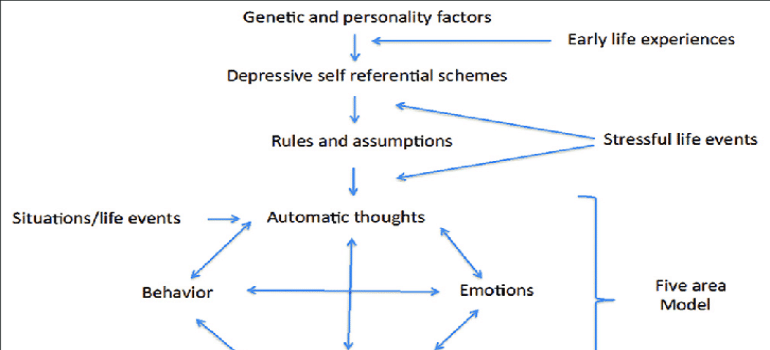
For example, Deepanjali Deshmukh identifies a 5-area model instead of the traditional 7 in ResearchGate:
What Cognitive Behavioral Therapy is Not
Evidently, cognitive behavioral therapy in drug addiction treatment remains an invaluable asset for therapists. However, there is still a decent amount of confusion on what CBT for addiction is not. Here’s what it cannot do:
- Psychoanalysis; CBT is not psychoanalysis. Although potentially useful in its own ways, psychoanalysis only partially overlaps with CBT in intended outcomes.
- Person-centered/ humanistic therapy; CBT is not “person-centered” in an academic sense.
- Universally accessible, while very flexible in its forms and applications, CBT is very structured. It requires cooperation, awareness, and willingness, which not all SUD cases offer.
- A substitute for medical assistance; finally, CBT can also not replace medication when needed, such as medically assisted treatment (MAT). It can synergize terrifically with pharmacological treatments, but not often replace them.

Benefits and Advantages of Cognitive Behavioral Therapy
- Cognitive awareness. As its explicit goal, this therapy makes the patient aware of negative, harmful, and simply inaccurate thoughts and worldviews. In doing so, it aligns with the 12 steps of Alcoholics Anonymous (AA) as regards acceptance prior to recovery.
- Flexibility. Because of its expansive scope and principal variety, as we outlined above, CBT can flexibly address many different disorders. It thus offers an excellent tool for therapy personalization.
- Short-term effectiveness. In addition, CBT has been found to have positive effects relatively early during therapy. In the aforecited article, VeryWellMind finds that “improvements can be seen in five to 20 sessions”. Such short-term effectiveness can, understandably, accelerate other concurrent treatments as well.
- Affordability. As regards costs, too, CBT is far from costly, typically costing less than many other types of therapy. In the US, the Affordable Care Act’s Medicaid benefits now cover cognitive behavioral treatment as well.
- Remote viability. Finally, similar to other types of counseling and talk therapy, CBT has also demonstrated effectiveness even in remote settings. This also expands its potential applications to online therapies.
Goals of Cognitive Behavioral Therapy
- Mental recovery: By accepting, challenging, and ultimately changing harmful and untrue thinking patterns, patients should achieve mental health improvements and learn how to deal with stress when recovering from addiction.
- Self-reliance; through self-assessment and self-help tools, patients should acquire risk management tools and knowledge to remain self-reliant throughout rehabilitation and beyond.
- Communication improvements; after extensive introspection and talk therapy, patients should achieve better communication, which further assists in maintaining substance abstinence.
Cognitive Behavioral Therapy in Drug Addiction Treatment
CBT finds ample applications in drug addiction treatment. To explain this in depth, here we may first cover its uses throughout different stages of addiction treatment.
#1 Partial Hospitalization

#2 Outpatient programs
Outpatient programs are where cognitive behavioral therapy in drug addiction treatment can truly begin to thrive. Now in residential settings, patients are much more capable of reaping the benefits of CBT.
For clarity, outpatient programs typically come in the following types:
- Intensive Outpatient programs (IOPs); the most intensive type of outpatient programs, as the name suggests, IOPs entail strict supervision. Patients do relocate to residential settings, but continue to receive intensive care and therapy to help ensure a successful rehabilitation.
- Outpatient Programs (OPs); finally, the typical outpatient program type is simply OP, which tones down the offerings of IOPs. OPs are typically reserved for patients who show great success toward rehabilitation and thus require less strict supervision.
Typically, almost any IOP Palm Beach treatment providers offer comes with some form of CBT. This is simply because most types of outpatient programs still deal with highly functional, post-detox patients who can embrace it. At this stage, patients participate in rigorous group therapy and individualized therapy sessions, which offer ample room for CBT.

#3 Aftercare programs
The final stage of rehab, the typical aftercare program, primarily focuses on relapse prevention, emotional support, and personal growth. Here, cognitive behavioral therapy in drug addiction treatment can shift its goals from developing initial coping skills to achieving long-term, self-sustained recovery.
Aftercare programs do differ quite significantly across treatment providers. However, they typically include an alumni program which can facilitate:
- Open communication channels; arguably the primary goal of such programs, open communication channels seek to offer post-rehab support. These can include social media groups, chat application groups, phone lines, and others. In all cases, communication is paramount, and in our context, a key component of CBT’s self-monitoring practice.
- Opportunities for socialization; another common goal of aftercare programs lies in socialization, as SUDs thrive on isolation and depression. To achieve this goal, aftercare programs will typically offer regular outings, where past and present patients can meet and socialize. This kind of CBT-minded peer support has often been found to substantially assist in reducing the chance of relapse.
- Continued support group therapy; finally, aftercare programs will, in most cases, include attending group meetings, which is where rehabilitated individuals can truly practice, hone, and maintain their self-reliance skills acquired through CBT.
Applications of Cognitive Behavioral Therapy in Drug Addiction Treatment
While the above should cover the fundamentals, now we may delve deeper into how exactly CBT finds its many applications.
First, it finds near-inherent synergies with other types of therapies. To illustrate this, consider the following:
- Dual diagnosis. Initially, dual diagnosis helps identify co-occurring mental disorders. In doing so, it helps therapists and patients cooperate toward identifying and addressing underlying addiction causes. Indeed, mental health issues do overlap with addiction somewhat, and one can fuel the other. In this context, CBT provides an excellent therapeutic tool toward a successful recovery.
- Trauma therapy. Similarly, trauma therapy also explores the underlying causes of SUDs in past trauma and seeks to address them. Fortunately, and in large part by design, trauma therapy intersects with CBT somewhat. Using techniques of both in combination can substantially improve recovery rates, as well as help prevent relapse.
- Holistic treatments. Another frequent characteristic of SUD treatment, holistic therapy, also leans heavily into the patient’s mental well-being. Typically applied in IOPs and beyond, holistic therapy offers fertile ground for psychological introspection and self-improvement. In this context, CBT principles can apply to psychotherapy of multiple types, serving the same ultimate goal.
- Group sessions. Finally, group therapy sessions arguably offer the best applications of cognitive behavioral therapy in drug addiction treatment. Group therapy will often explicitly include CBT models right from the start. Group sessions focus on psychoeducation, life skill acquisition, and emotional support, among others, leveraging group dynamics to do so. CBT overlaps with these goals and techniques substantially, and can fuel 12-step recovery groups, emotional management sessions, and a wealth of other self-improvement activities.

Is Cognitive Behavioral Therapy in Drug Addiction Treatment Effective?
CBT may sound foreign, largely theoretical, and perhaps too idealistic. To the average person, it may sound like jargon with little use and questionable potential benefits at best. This is perfectly understandable – but rest assured, it’s far from the case.
Cognitive behavioral therapy in underlying, co-occurring mental health disorders
First, consider how the Center for Personal Growth identifies CBT as the “gold standard” for mental health disorder treatment:
This factor alone should help illustrate the efficacy of CBT for drug addiction treatment as well. The dual diagnosis principle finds considerable overlap between the two, including in relapse probability, so CBT offers fundamental benefits from the very first stages of treatment to the last.
Cognitive behavioral therapy in drug addiction treatment and SUDs
But even without this element in mind, ample research has documented the efficacy of CBT toward SUD treatment. In our context, the benefits of cognitive behavioral therapy in drug addiction treatment, in particular, have been proven time and again.
Take R. Kathryn McHugh, Bridget A. Hearon, and Michael W. Otto, for example, whose research published in NIH finds that:
“[CBT] for substance use disorders has demonstrated efficacy as both a monotherapy and as part of combination treatment strategies. […]Evidence from numerous large scale trials and quantitative reviews supports the efficacy of CBT for alcohol and drug use disorders. […]Evidence also supports the durability of treatment effects over time.”
To demonstrate this point further, they later also note that:
“Studies evaluating the relative efficacy of different cognitive-behavioral approaches for SUDs have yielded equivocal results with regard to the relative benefits of these approaches for drug use outcomes. […] However, results of effect size analysis across treatment trials provide support for the most robust treatment effects for contingency management for drug use.”
They do recognize the remaining challenges with CBT, of course, as it is an evolving field. Still, their findings leave little room for doubt; CBT evidently works.
Cognitive Behavioral Therapy Is a Game-Changer
Cognitive behavioral therapy in drug addiction treatment can help patients cope with withdrawal symptoms, understand their deeper psychological challenges, and adjust their mindsets to facilitate recovery. This non-invasive type of talk therapy can complement an array of established treatment practices across all rehabilitation stages. It can inform trauma therapy, fuel holistic therapies and introspection, and augment emotional support practices. Across its different forms, it offers patients an array of tools they can use to achieve self-reliance and personal growth. While by no means a standalone miracle treatment, CBT presents new opportunities to personalize treatments and help ensure success. At Bright Futures Treatment in Florida, it has been an invaluable asset toward fulfilling our mission, and an integral part of our treatment services.
Contact Us
Gallery






 Get Started